- OLAP 不需要像 OLTP 一样索引单个 tuple,文件通常也是不可变的。
- **Sequential Scan Optimizations**:
- Data Prefetching / Scan Sharing
- Task Parallelization / Multi-threading
- Clustering / Sorting
- Late Materialization
- Materialized Views / Result Caching
- Data Skipping
- Data Parallelization / Vectorization
- Code Specialization / Compilation
- **Data Skipping**
- **方式一:Approximate Queries(Lossy)**
- 在整个表的一个采样子集上进行查询,输出近似结果
- 示例:BlinkDB,[Redshift](https://docs.aws.amazon.com/redshift/latest/dg/r_COUNT.html),ComputeDB,XDB,[Oracle](https://oracle-base.com/articles/12c/approximate-query-processing-12cr2),[Snowflake](https://docs.snowflake.com/en/user-guide/querying-approximate-frequent-values),[BigQuery](https://cloud.google.com/bigquery/docs/reference/standard-sql/approximate_aggregate_functions?hl=zh-cn),[DataBricks](https://docs.databricks.com/sql/language-manual/functions/approx_count_distinct.html)
- **方式二:Data Pruning(Loseless)**
- 使用辅助数据结构,根据谓词快速判断可以跳过哪部分数据
- DBMS 需要在 scope 与 filter efficacy、manual 与 automatic 之间进行权衡
- scope vs. filter efficacy:两个极端:为整个 table 建立 min/max 对比 为每个 tuple 建立
- manual vs. automatic:如 zone maps 通常是自动维护的,bitmap 一般需要手动创建
<br>
- **Data Considerations**
- **Predicate Selectivity**:满足某个查询谓词的有多少 tuples
- **Skewness**:某列所有的值都是不同的 或者 包含了许多重复的值
- **Clustering / Sorting**:某个查询条件涉及到的列是否已经排好序
------------
# 1. Zone Maps
- 为一个 block 内的 tuples 预先计算一些聚合信息。DBMS 首先查看 zone map 来判断是否需要访问该 block。
- 最初称为[ Small Materialized Aggregates(SMA)](https://www.vldb.org/conf/1998/p476.pdf)
- DBMS 自动地创建/维护
- **Scope vs. filter efficacy trade-off**
- 如果 scope 太大,则 zone maps 变得无用
- 如果 scope 太小,则 DBMS 需要花费太多时间来检查 zone maps
- Zone Maps are only useful when the target attribute's position and values are correlated.
- 反例:比如 values 分布完全随机,检查每个 block 的 zone map 时都返回 true
------
# 2. Bitmap Indexes
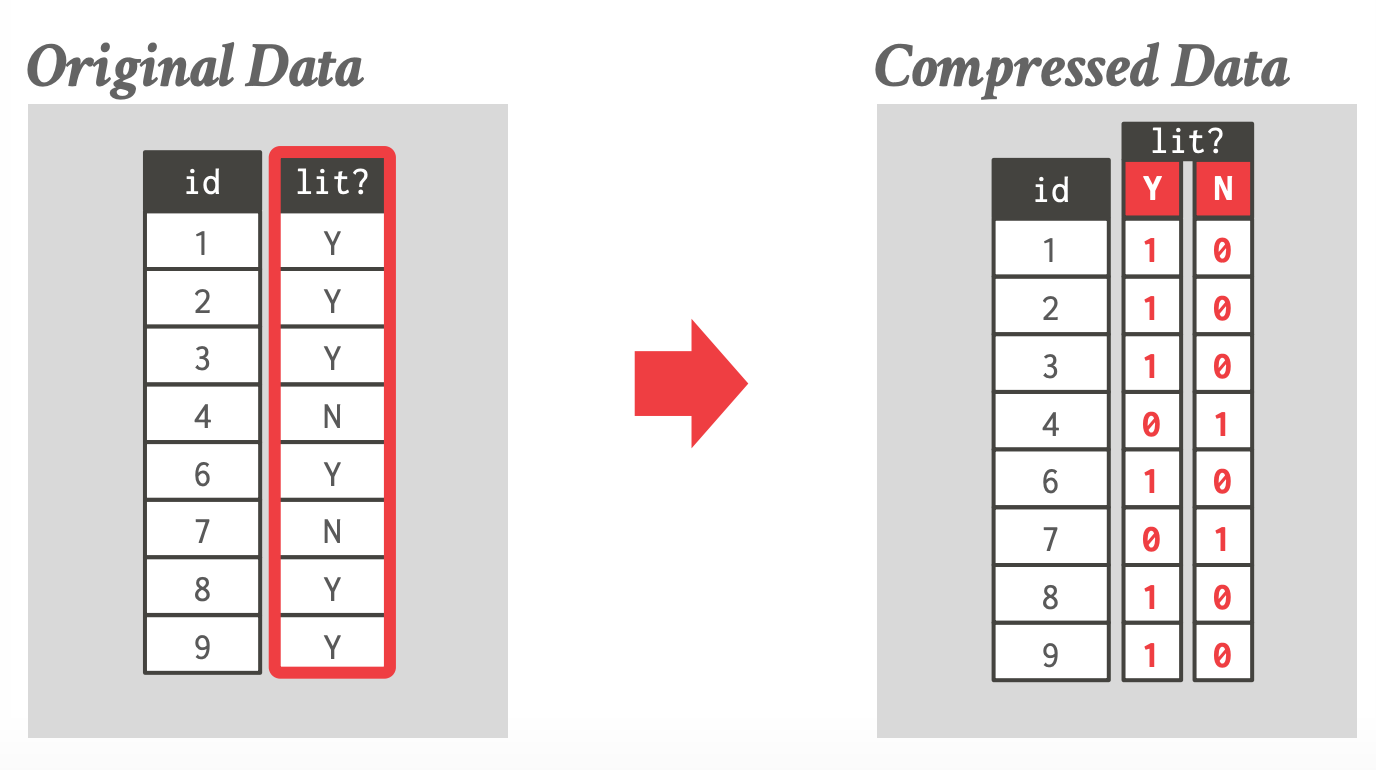
- 为每个不同的列值维护一个 bitmap,bitmap 里存储哪些行包含该列值
- bitmap 的 $i^{th}$ 为 1 表示第 $i^{th}$ tuple 的拥有该列值
- 通常划分为 chunks 来避免分配大块连续的内存。
## 2.1 Design Choices
- **Encoding Schema**
- 如果在一个 Bitmap 内表示和组织数据
- 本节课主要涉及
- **Compression**
- 如何减少稀疏 Bitmaps 的大小
## 2.2 Encoding
几种方式:
- **Equality Encoding**
- 最基本方式,每个不同的值对应一个 Bitmap
- **Range Encoding** ^9b6f0f
- 每个区间对应一个 Bitmap。**存在 false positive**
- 示例:[PostgreSQL BRIN](https://www.postgresql.org/docs/current/brin-intro.html)
- **Hierarchical Encoding**
- 使用 tree 结构来表示空的 key ranges
- **Bit-sliced Encoding**
- Use a Bitmap per bit location across all values
## 2.3 Hierarchical Encoding
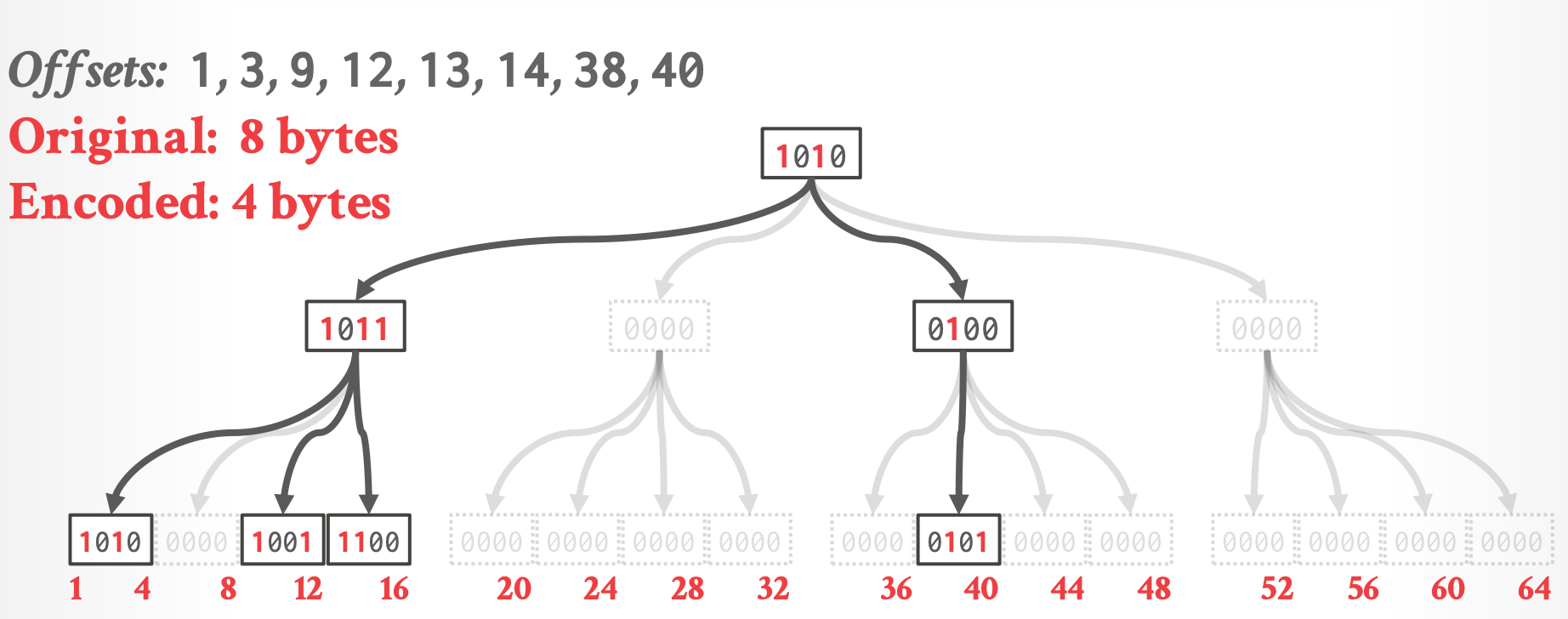
- 每个 node 自身也是一个 bitmap,第 N 位表示它的第 N 个 child 是否为空
- 虚线的部分不存储
**缺点**:
- 对现代 CPU 不友好,访问的内存不连续(许多 indirection)
## 2.4 Bit-Sliced Encoding
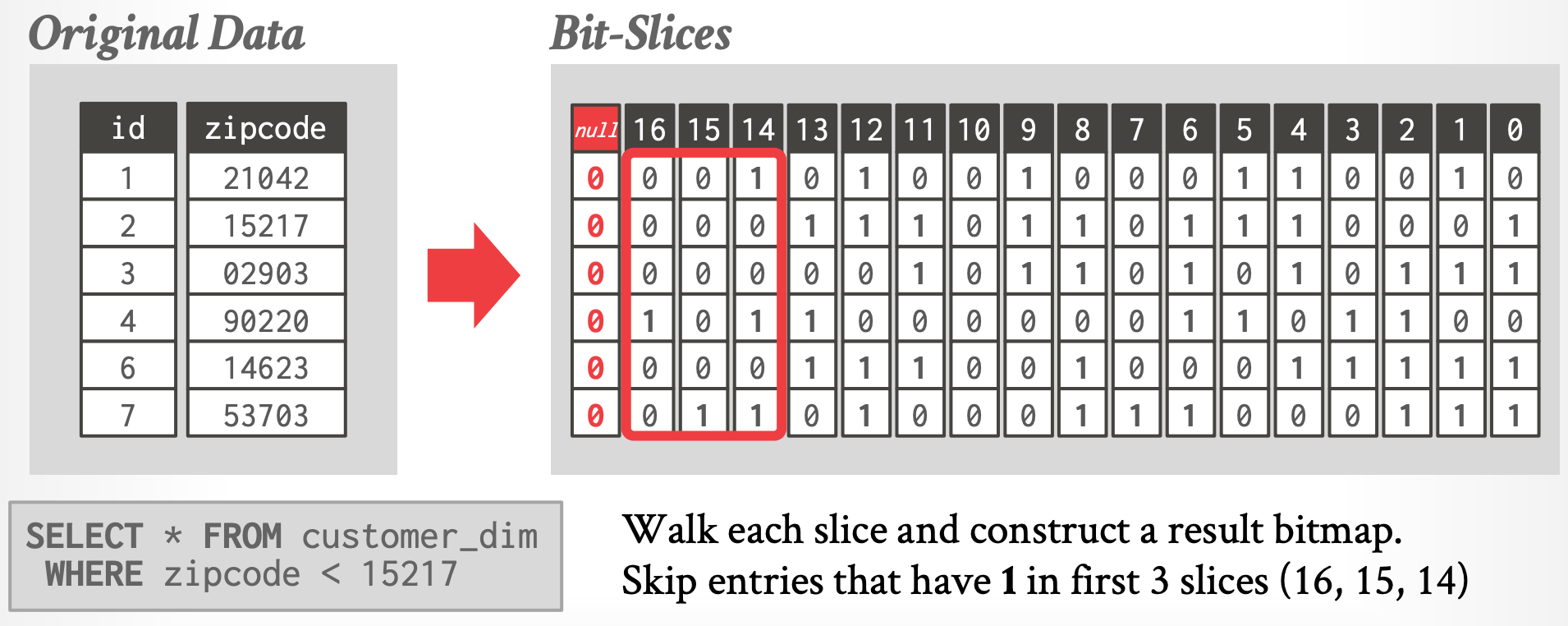
- 其中 $\large bin(21042)→ 001010 0 10001 10 010$
- 将列值对应的 bits 按位拆开,类似行存转列存(一个 bit 可以看作一列),将所有行的第 $i$ 位存储在一起(对应图中,Bitmap/Slice 的方向是**上下**的)
- 计算 Predicate 时,一些场景下只比较前面几个 Slice 就能快速 Pruning(如图中例子)
- 可以用于高效地进行聚合计算
- 如 `SUM(attr)` 使用 [Hamming Weight](https://en.wikipedia.org/wiki/Hamming_weight)
1. 计算 $slice_{17}$ 中 1 的个数,然后乘以 $2^{17}$
2. 计算 $slice_{16}$ 中 1 的个数,然后乘以 $2^{16}$
3. 以此类推...
- Intel 在 2008 年添加了 **POPCNT** SIMD 指令,可以计算 1 的个数
- 限制:
- 列值的二进制位数不能太多
## 2.5 BitWeaving
- 更现代化的 Bit Sliced
- 设计目的:使用 SIMD,在压缩过的数据上可以快速进行 predicate evaluation。
- Bit-level parallelization
- 学习材料:
- 实现:[Quickstep](https://quickstep.cs.wisc.edu/)
- Paper:[BitWeaving: fast scans for main memory data processing](https://dl.acm.org/doi/10.1145/2463676.2465322)
- Note: https://dsg.uwaterloo.ca/seminars/notes/2014-15/Patel-Quickstep.pdf
- 两种 Storage Layouts:
1. **Horizontal**:Row-oriented storage at the bit-level
2. **Vertical**:Column-oriented storage at the bit-level
### Horizontal Storage
**存储:**
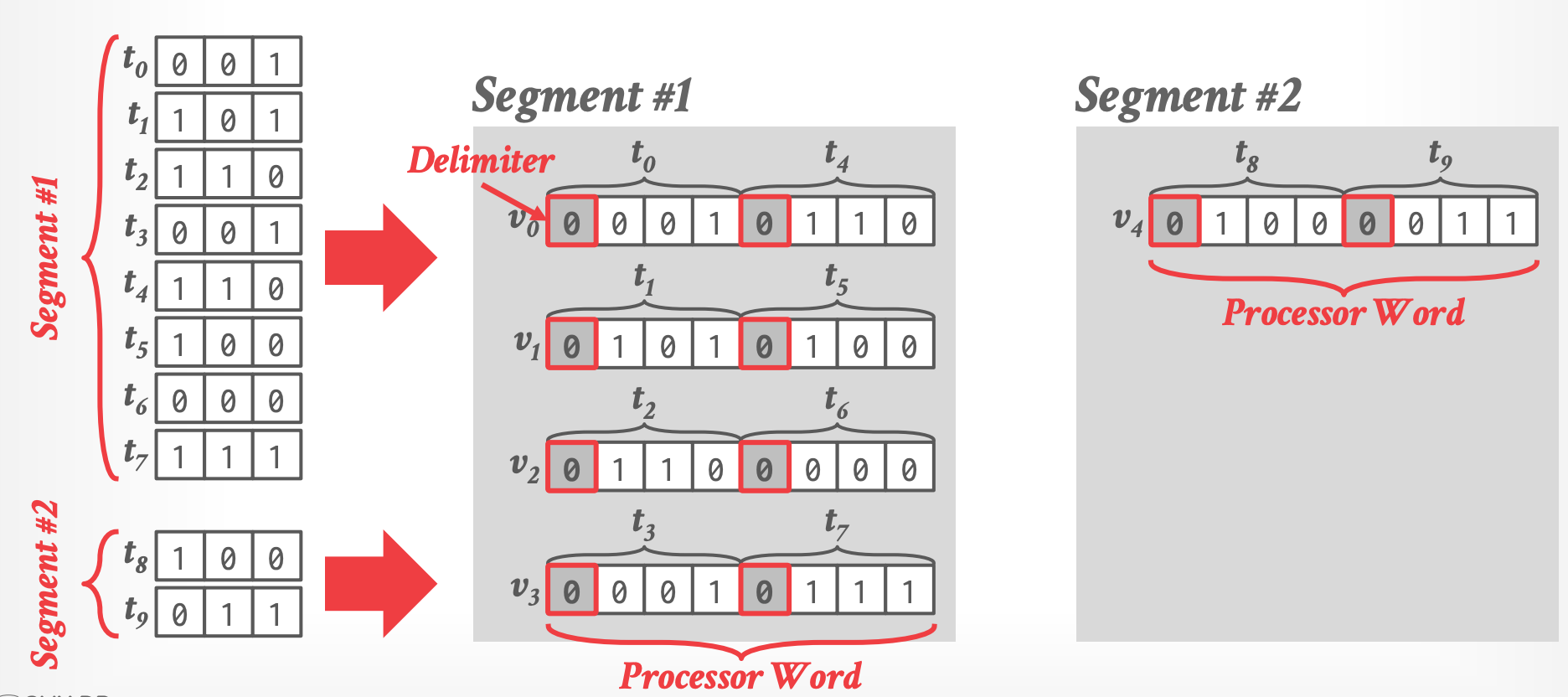
- 图中假设机器字是 8 bits(packed to word)
- tuples 是穿插在一起的,如 $t_0$ 和 $t_4$ 在一起。
- Delimiter 用于后续的计算
**谓词计算:**
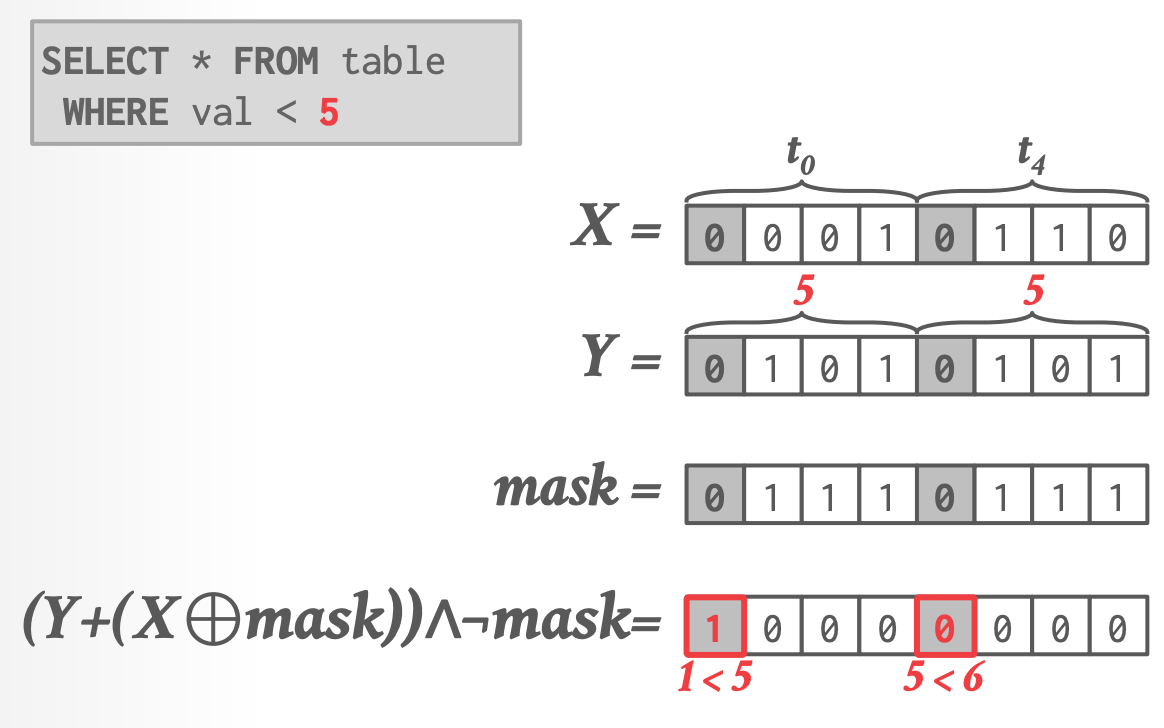
- 计算结果是 selection vector,表示哪些 tuple 匹配到了
- 一个 word 的计算只需要三个指令
- 可以工作于任意的 word size 和 encoding length
- 论文里还包含了其他计算的算法
### Selection Vector
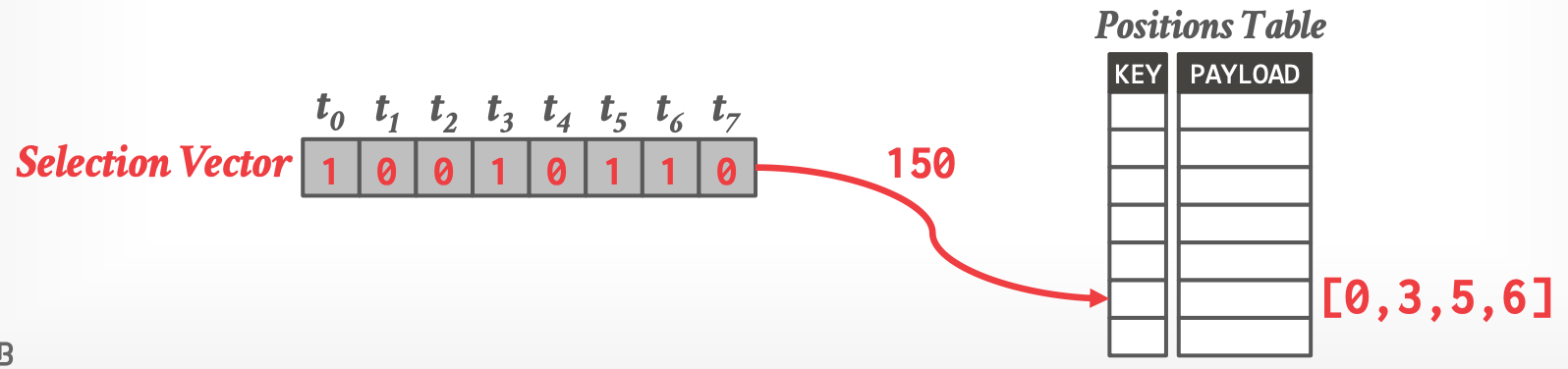
- SIMD 比较操作的输出是一个 bit mask,表示了哪些 tuples 满足谓词。
- DBMS 必须将其转化成 column offsets,两种方式:
1. Iteration
2. Pre-computed Positions Table ^e235f5
- 
### Vertical Storage
**存储:**

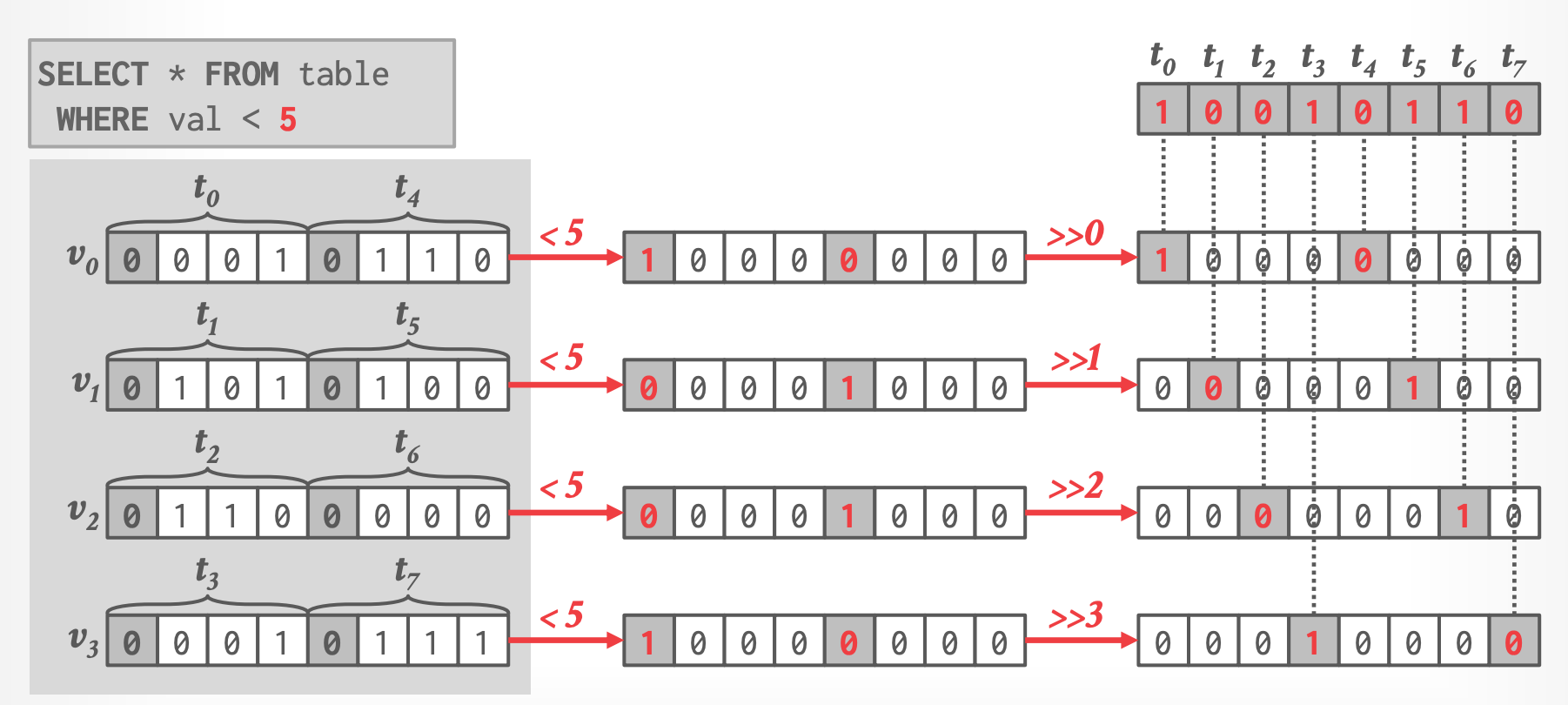
- segment 内所有 tuple 的第 $i$ 位存储打包到一个机器字内
**计算:**
1. 
2. 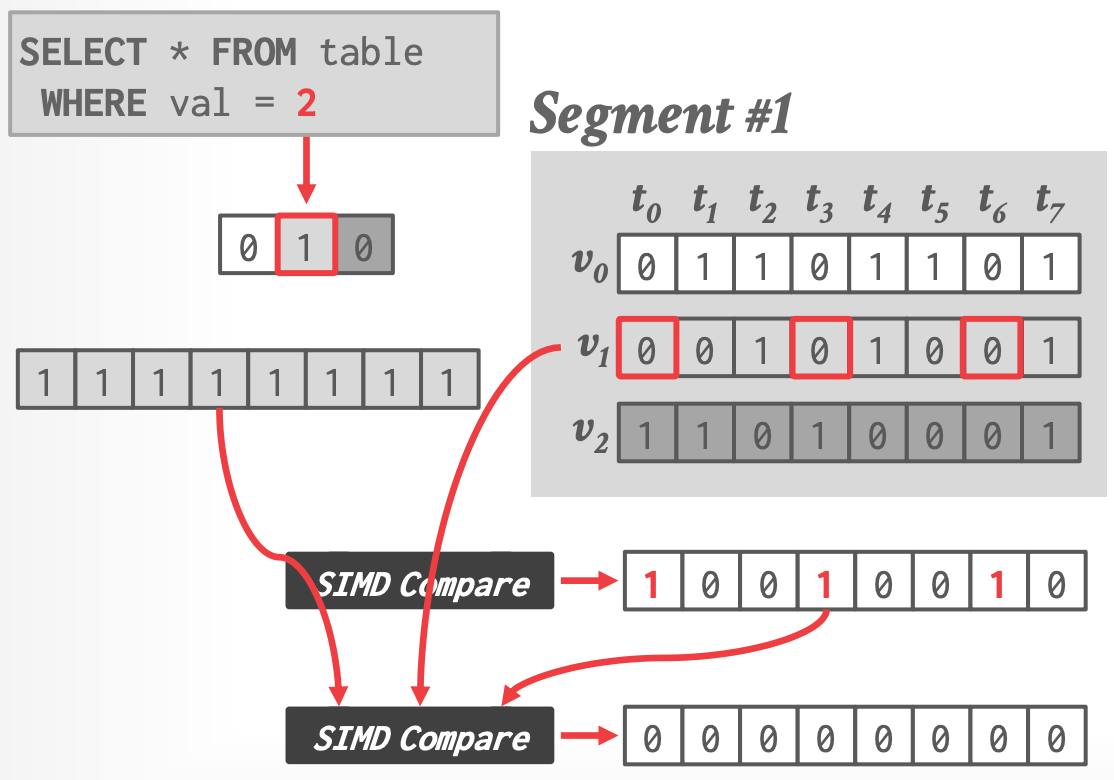
- 相比 Horizontal Storage 更高效
- 优势:可以 early quit(如上图中比较结果为 全 0 时)
## Observation
- 前面的 Bitmap 机制都是精确/无损的
- DBMS 也可以选择放弃一些精确度,来换取更快的计算速度
- 存在 false positives,还需要查看原始数据
---------
# 3. Column Imprints
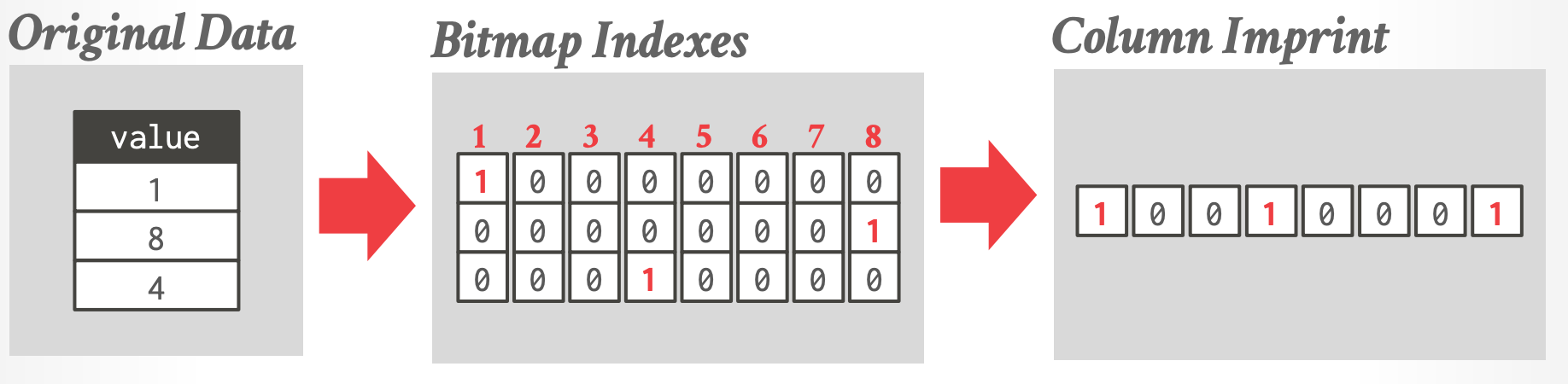
- 从上到下将 bitmap 合并到一起成一个 bitmap
- 来判断是否存在某个 value,类似 bloom filter
- 论文:[Column imprints: a secondary index structure](https://dl.acm.org/doi/10.1145/2463676.2465306)
----------
# 4. Column Sketches
- [[04-olap-indexes#^9b6f0f|range-encoded Bitmap]] 的变种
- Paper:[Column Sketches: A Scan Accelerator for Rapid and Robust Predicate Evaluation](https://dl.acm.org/doi/10.1145/3183713.3196911)
- 使用 smaller sketch codes来标识是否存在处于某个范围内的值
- DBMS must automatically figure out the best mapping of codes.
- Trade-off between distribution of values and compactness.
- Assign **unique codes to frequent values** to avoid false positives.
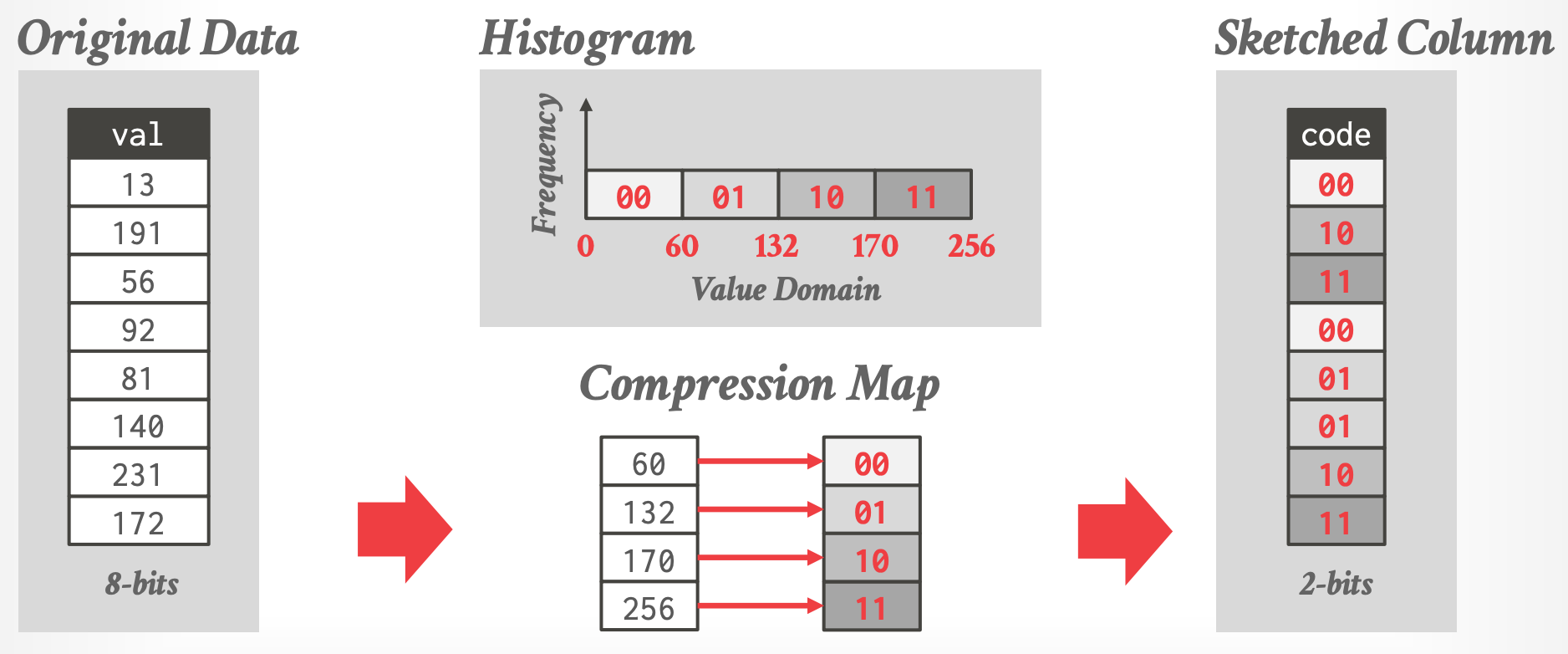
- 例如 00 表示小于 60,01 表示 $[60, 132)$
- 不存储原始列值,而是存储 code
- 应用:如 `SELECT * FROM table WHERE val < 90`,只需要查找 code 等于 00 和 01 的
----------
# Parting Thoughts
- Zone Maps 被广泛用于加速 sequential scans
- Bitmap indexes 在 NSM DBMS 中更常见(相比 columnar OLAP systems)